Wren tried to ship a landing page headline.
She got rejected before a single person read it.
Wren is the AI copywriter in our agent system at Social Ads Mentor. She handles ad copy, email subject lines, landing page sections, all of it. She runs as a specialist inside a ten-agent system that does real work for real clients every week.
Four drafts. Four rejections. Not from me. From the next step in the system that reviews her work before it ships.
That is what a real quality process looks like inside an AI-powered agency.
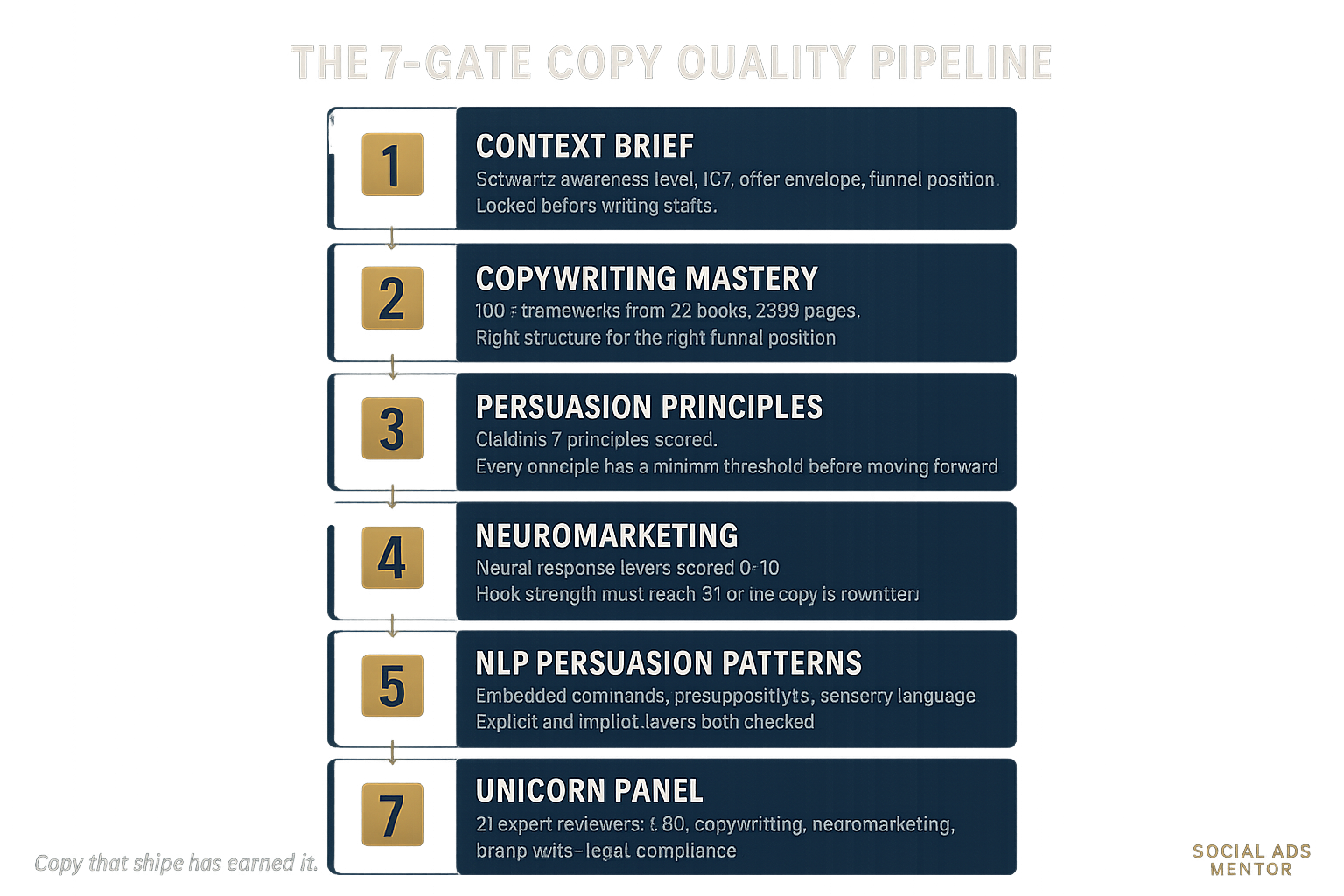
This post breaks down the exact 7-checkpoint system, why it exists, what happened when Wren kept failing Checkpoint 6, and what coaches, consultants, course creators, and service providers can take from this for their own copy process, even if they work alone.
Why Most AI Copy Fails Before You Even Notice
Most people who use AI to write copy do the same thing.
They type a prompt. They get a draft. They read it quickly. They publish.
If it sounds clean and makes sense, it ships.
The problem is that "sounds clean" is not the same as "actually persuades people."
A draft can be polished, correct, and well-organized and still get zero clicks, zero replies, and zero conversions.
Because it never had to pass anything.
It never had to prove the first line would make someone stop scrolling. It never had to prove the proof was real and specific, not vague and generic. It never had to prove it was written for the right reader.
Single-pass AI copy is copy that never got tested.
That is why we built the 7-checkpoint system.
What the 7-Checkpoint System Is
Every piece of copy at Social Ads Mentor passes through 7 steps before it reaches a client or goes live.
Each step is handled by a different specialist in the system with a specific job to do.
If any step fails the copy, the draft bounces back to Wren with specific notes. She rewrites. The process starts again from the failed step.
Here is what each checkpoint does.
Checkpoint 1: Brief Check
Before Wren writes a single word, Checkpoint 1 checks that the brief is complete.
This means answering one simple question: does the writer actually know who is reading this and what they need?
There are 5 types of readers, based on where they are in their thinking:
- Someone who does not know they have a problem
- Someone who knows the problem but does not know a solution exists
- Someone who knows solutions exist but has not picked one
- Someone who knows about your offer but has not decided yet
- Someone who knows your offer well and just needs a reason to act right now
Copy written for one type of reader sounds completely different from copy written for another.
If the brief does not spell out which reader you are writing for, Wren writes for the wrong one. And every step after that catches the mistake.
Checkpoint 1 also checks: has the unique angle been named? Has the target audience been described with enough detail? Has the content type been stated?
If any of those are missing, the brief comes back before Wren even starts.
This sounds like extra work. It is not. Every copy failure we have ever traced back started with a brief that did not answer these questions.
Checkpoint 2: Framework Match
Once Wren drafts, Checkpoint 2 checks the structure.
There are dozens of proven ways to organize copy. The question is whether you are using the right one for what you are trying to do.
A few examples:
Problem-Agitate-Solve works for a warm email sequence where the reader already knows they have an issue.
Attention-Interest-Desire-Action works for a cold-traffic ad where the reader does not know you yet.
Before-After-Bridge works for a story-driven social post showing a transformation.
Hook-Story-Offer works for a build-in-public carousel like this one.
Each structure has a specific job. Using the wrong one for your content type is like using a hammer to tighten a screw. The tool is not bad. It is just the wrong tool for this job.
Checkpoint 2 catches that mismatch and sends back the right structure for Wren to rebuild around.
Checkpoint 3: Trust Triggers
Checkpoint 3 checks whether the copy gives people real reasons to believe it.
There are 7 specific ways that copy earns trust from readers:
- Give something useful before asking for anything
- Connect to something the reader has already said yes to
- Show specific, named examples of people who have gotten results
- Demonstrate that the source actually knows what they are talking about
- Make the reader feel like you understand their world
- Give a real, specific reason to act now rather than later
- Speak to a shared identity or shared values
Each one of these has a minimum standard it has to meet before the copy moves forward.
A draft that scores zero on any of the critical ones does not ship.
Checkpoint 3 does not demand that every element be present in every piece of copy. It demands that nothing important be completely missing for the type of copy in question.
Checkpoint 4: Brain Hooks
Checkpoint 4 measures one thing: does the first line make you stop?
Think about how you scroll a feed. You are moving fast. Something catches your eye. You slow down. Maybe you stop.
What made you stop?
It was one of 8 things: something unexpected, something new, something that made you feel like you belong, something that spoke directly to who you want to be, something that pointed forward toward a result you want, a specific image that felt real, a sharp contrast between where you are and where you could be, or the feeling that you might miss out on something.
A hook that does not hit at least 8 of 10 on these does not clear Checkpoint 4.
Most single-pass AI hooks score between 5 and 7. They are fine. They are not stopping anyone.
Checkpoint 4 forces Wren to keep rewriting the opening until it actually earns the reader's attention.
Checkpoint 5: Word Choice
Checkpoint 5 looks at two layers of the copy.
The first layer is the obvious one: what is the copy actually saying? What is the claim? What is the proof? What is the call to action?
The second layer is less obvious: what is the copy implying? What does the reader automatically assume as true just from the way the sentences are structured? What state of mind are the words putting the reader in?
The best copy works on both layers at the same time.
Saying "most AI copy that does not convert has never had to pass anything" is a direct claim. It is also quietly implying: if you are using AI copy and it is not working, you already know this is the reason.
Checkpoint 5 checks both layers and flags anywhere the implied message contradicts the stated one.
Checkpoint 6: Proof Check
This is where Wren failed four times.
Checkpoint 6 goes through every claim in the copy and asks a simple question: can a skeptical reader actually check this?
Vague claims bounce:
- "quality tested by experts" = who? How many? By what standard?
- "proven system" = proven how? By whom?
- "backed by industry research" = which research? Where?
Specific claims pass:
- "copy passes through 7 checkpoints before it ships"
- "the hook has to score 8 out of 10 before it moves forward"
- "21 different types of readers review the copy before it launches"
The difference is not about sounding confident versus sounding humble. It is about whether the claim can hold up when someone reads it closely.
Wren's first four drafts on the landing page hero section used language like "quality tested by industry experts" and "our system uses proven copywriting methods." Checkpoint 6 bounced them all with the same feedback: no specifics, no verification path.
Draft 5 named the checkpoints. Named the thresholds. Named the number of reviewers.
Checkpoint 6 passed it.
That is the draft that launched.
The client never read the first four.
Checkpoint 7: Expert Panel
Checkpoint 7 is the final review before anything ships.
The expert panel is 21 different types of readers reviewing the copy from their own angle. A direct-response copywriter. A media buyer. A skeptical first-time visitor. A cautious buyer. A lawyer. A data-minded reader. A brand strategist.
The question Checkpoint 7 asks: does this copy hold up when completely different types of readers look at it?
A headline a copywriter loves might read as hype to the cautious buyer. A landing page a strategist approves might not give the skeptic enough reason to believe it.
Checkpoint 7 catches those gaps before they become live problems.
All 21 have to agree before the copy ships. If the panel does not clear the draft, it goes back to Wren with the specific objection noted.
What Happened When Wren Failed Checkpoint 6
The four bounces happened fast.
Draft 1: "quality tested by industry experts." Bounced. No expert named. No standard described. No way to check.
Draft 2: "our system draws from 22 key source texts." Bounced. Which sources? How does drawing from them improve the copy? The claim raises more questions than it answers.
Draft 3: "copy passes through a multi-step review process." Bounced. How many steps? What do the steps measure? "Multi-step" tells the reader nothing useful.
Draft 4: "reviewed by experienced copywriters and strategists." Bounced. How many? Which disciplines? What does "experienced" mean here?
Draft 5: "copy passes through 7 checkpoints, including a hook strength test and a 21-reader panel. Every claim in this copy has been checked for specificity." Checkpoint 6 cleared it.
One short section. Five rounds.
That is not a slow process. That is a quality process. The slow process is publishing Draft 1, watching it underperform, wondering why, and starting from scratch a month later.
The client received a hero section that held up under scrutiny. They never knew how many rounds it took to get there.
How to Run a Version of This Yourself
You do not need a 10-agent system to put this into practice.
Here is the minimum version for a one-person operation.
After your first AI draft, ask yourself these 4 questions before you publish:
- Does every claim have a real number or a real name attached? (Checkpoint 6 check)
- Does the first line make you slow down when you read it out loud? (Checkpoint 4 check)
- Is this written for the right type of reader, someone who already knows they have a problem, or someone who does not know yet? (Checkpoint 1 check)
- Is there at least one piece of proof that a skeptical reader could actually verify: a named result, a specific count, a real date? (Checkpoint 3 check)
Four questions. Two minutes.
This is not the full 7-checkpoint system. But it catches the most common reasons AI copy fails before it reaches your audience.
The copy that comes out the other side will do more work than the single-pass draft.
Because it had to prove itself first.
The One Idea Behind All 7 Checkpoints
Most copy that does not convert is not bad.
It is copy that never had to prove itself.
The checkpoints are not about being a perfectionist. They are about building a filter that stops the weak draft before it reaches your audience.
Because your audience will reject it anyway. The only question is whether you catch it first or they do.
Wren's fifth draft was better than anything that would have shipped the first time.
Not because the tool changed.
Because the standard changed.
What's Next in the Build
In the next email I'll break down the memory layer: how knowledge created by any agent in the fleet immediately becomes available to all of them, and why that compounds in a way that a single conversation window never can.
If you want the full 7-checkpoint breakdown, including the exact setup for each checkpoint and how to run the Proof Check yourself on any piece of copy, that is inside The Mentor Lab on Skool.
Join here: https://1fb.me/lab-skool
Coaches, consultants, course creators, and service providers: your AI copy is only as good as the standard it has to meet before it goes live.
Build the checkpoints.
Then trust the output.
See also: Build in Public for all drops in this series, and How the 10-Agent Fleet Works for the full system overview.